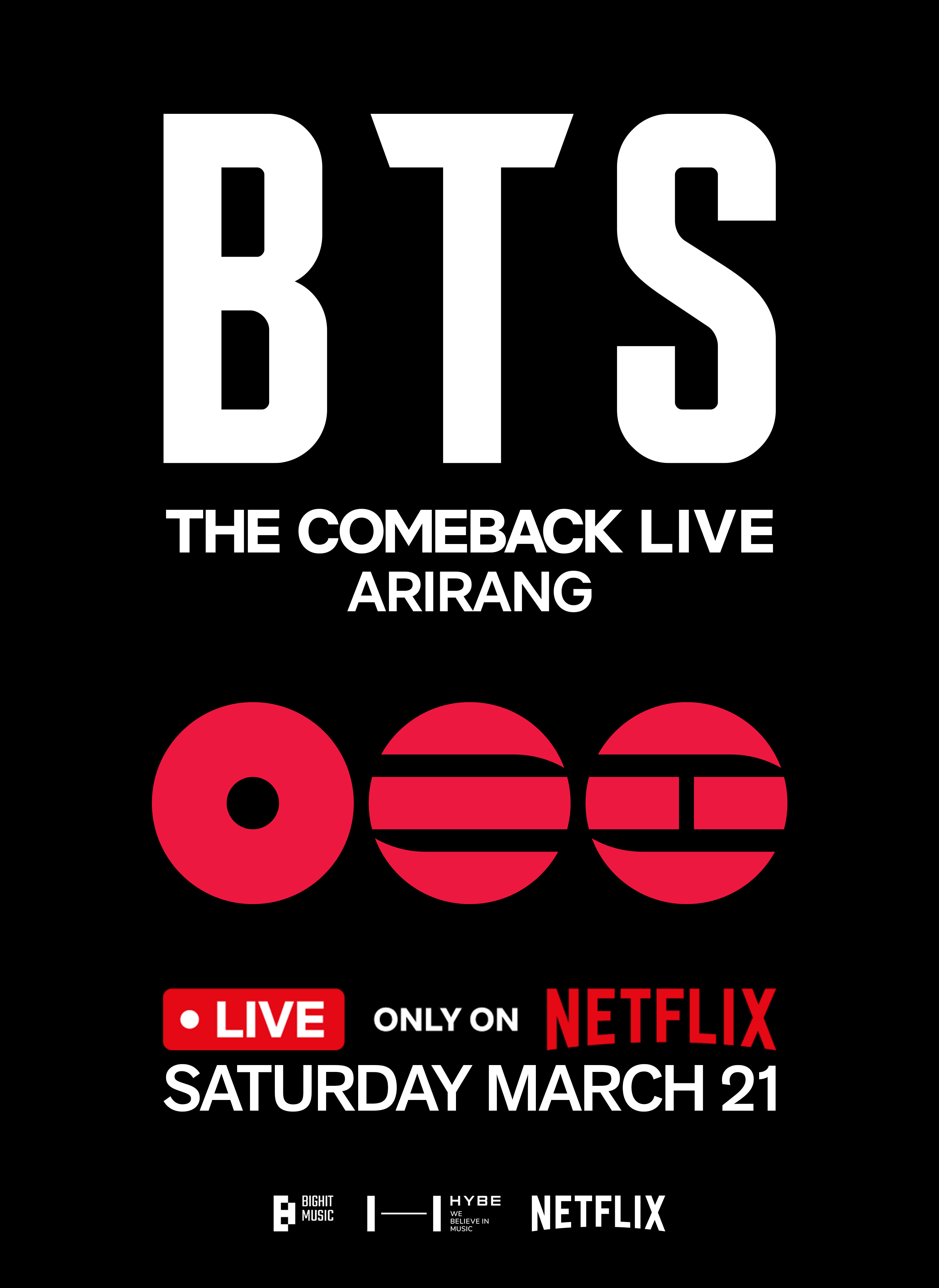
A comeback used to mean a new album and a series of televised performances. When BTS returns with ARIRANG, it becomes something else entirely: a test case for how global pop culture reorganizes itself around platforms rather than venues. The decision to stage BTS Comeback Live: ARIRANG through Netflix signals more than distribution convenience. It reframes the idea of where a concert actually happens.
The question is no longer who can enter a physical square in Seoul. It is how millions, scattered across time zones, can inhabit the same moment without sharing geography.
The Stage Is No Longer a Place but a Shared Timestamp
When a performance is built for global live streaming, the defining feature is simultaneity. Viewers do not just consume a show; they occupy the same time frame. That shift matters because pop music, especially in the case of BTS, has always relied on collective emotion—chants, synchronized light sticks, social media surges.
A platform like Netflix collapses physical distance into a synchronized digital event. Instead of fans watching fragmented clips hours later, the world meets the performance at once. The emotional arc becomes collective again, but digitally mediated.
Why this matters is simple: fandom evolves from spatial gathering to temporal gathering. The “venue” is not a city square; it is a shared global clock. That reframes what it means to attend.
From Concert Broadcast to Cinematic Live Experience
With Hamish Hamilton directing, the event moves beyond static concert documentation. Hamilton’s history with large-scale spectacles—from the Super Bowl halftime show to the 2012 Summer Olympics opening ceremony—suggests a grammar of live performance that blends intimacy with scale.
That cinematic grammar transforms how viewers perceive idols. Close-up shots capture breath and micro-expressions; sweeping crane movements restore grandeur. The live stream becomes a hybrid form: neither pure cinema nor raw concert footage.
Why this matters is that BTS’s comeback is not framed as a simple performance cycle. It becomes an authored live narrative, shaped in real time. The audience is guided emotionally, not just visually.
Platform Strategy: Why Netflix Needs This Moment
Netflix expanding into large-scale live music signals a strategic shift. For years, its strength lay in on-demand storytelling. Live events introduce risk—technical instability, unpredictability—but also urgency.
Urgency is the currency streaming platforms struggle to manufacture. A comeback event provides it naturally. Fans cannot pause the cultural moment without missing something intangible: the shared reaction, the synchronized surprise.
In this sense, BTS is not merely content on Netflix. The group becomes a catalyst for redefining Netflix’s identity—from library to arena. That transformation matters for the broader streaming ecosystem, where differentiation increasingly depends on experiential exclusivity rather than catalog size.
ARIRANG as Cultural Signal, Not Just Album Title
The choice of “ARIRANG” invokes a traditional Korean folk motif, layered with themes of longing and resilience. For a group returning after a long hiatus, the symbolism feels deliberate.
Yet the cultural framing is not nostalgic retreat. By launching through a global platform, the project projects Korean heritage outward rather than inward. Tradition becomes exportable in real time.
Why this matters is that BTS has long functioned as a bridge between local identity and global pop structures. A comeback under this title, distributed worldwide simultaneously, reinforces that duality. It asks whether cultural specificity strengthens universality rather than limiting it.
Documenting the Return as Myth-Making
The accompanying documentary, BTS: The Return, directed by Bao Nguyen, extends the comeback beyond performance. If the live event captures the explosion, the documentary captures the compression—the doubt, discipline, and recalibration preceding it.
This layered rollout turns a musical return into narrative architecture. The public moment gains depth through retrospective framing. Viewers are invited to interpret not only what is performed, but what it cost.
Why this matters is that modern pop stardom thrives on transparency aesthetics. Audiences expect process, not just product. By pairing spectacle with introspection, the comeback becomes a study in construction rather than a single night’s climax.
Global Fandom Without Physical Borders
For international fans who cannot attend in person, the traditional hierarchy between “those who were there” and “those who watched later” dissolves. If everyone watches live, physical absence loses its sting.
This is not merely technological convenience. It rebalances access. K-pop has often depended on pilgrimage—traveling to a specific city, securing tickets, occupying proximity. Streaming equalizes the starting point.
Why this matters is that it challenges the prestige economy of fandom. Attendance becomes temporal rather than geographical. The status marker shifts from location to participation in the moment.
The Risk of Turning Music Into Platform Event
There is, however, a structural tension. When a comeback doubles as a platform milestone, the music risks being overshadowed by the infrastructure. Headlines may focus on technological firsts rather than the sonic evolution itself.
This raises a broader question about contemporary pop cycles. Are albums now catalysts for corporate expansion strategies? Or do platforms simply amplify what artists already command?
The answer likely lies somewhere between. BTS has the scale to redefine platform behavior, but platforms also reshape how comebacks are perceived—less as artistic chapters, more as global synchronization events.
A New Blueprint for Pop Returns
If this model succeeds, it may redefine expectations for future major artists. Comebacks could increasingly function as cross-media spectacles: live-streamed premieres, behind-the-scenes documentaries, algorithm-driven global chat surges.
Yet the durability of such a model depends on emotional authenticity. Spectacle without resonance fades quickly. The simultaneous global stage works only if the performance itself sustains meaning.
When the concert becomes a timestamp shared worldwide, intimacy takes on a different form. It is no longer about proximity to the stage, but proximity to the moment. Whether that shift deepens connection or transforms it into scale-driven consumption remains an open question.