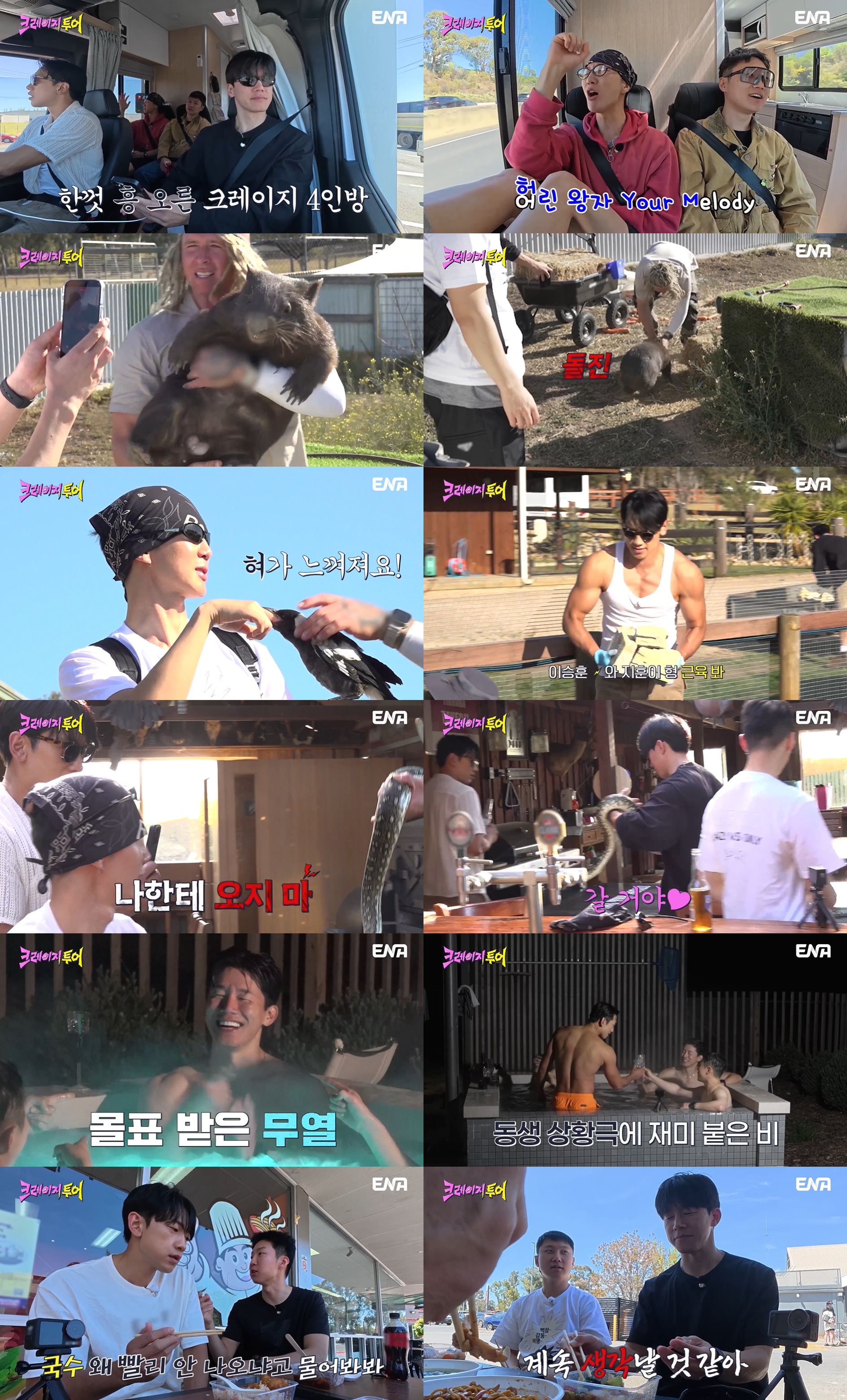
Travel variety shows often rely on comfort. Familiar chemistry, predictable roles, and a steady rhythm of “healing” moments keep things easy to consume. Crazy Tour becomes more compelling precisely when it breaks that structure. This episode doesn’t just show a trip across Australia—it quietly dismantles the hierarchy that usually stabilizes shows like this.
What begins as a scenic detour turns into something closer to a controlled collapse. Status fades, roles shift, and the cast are forced into situations where their usual identities stop functioning. That shift matters because it transforms the show from passive travel content into something closer to a social experiment.
Nature in this episode refuses to behave like content
Animal encounters in variety shows are typically designed to be safe emotional anchors. They soften the tone, create easy reactions, and give viewers a break from conflict. Here, that expectation is disrupted almost immediately.
The wombat, initially framed as a source of pure “healing,” turns unexpectedly territorial. The python’s appearance amplifies that instability. These moments don’t just create laughter—they remove control from the cast. The environment stops being something they consume and becomes something they have to react to.
That shift is critical. When nature doesn’t cooperate, performance collapses. Carefully maintained personas—whether built on strength, composure, or experience—lose their structure. What emerges instead are instinctive reactions: fear, hesitation, awkwardness. The show becomes less about showcasing personalities and more about exposing them.
Labor replaces performance, and that changes everything
The act of building a tunnel for the wombat looks minor compared to the louder moments in the episode, but structurally, it’s one of the most important sequences.
Physical work slows everything down. It removes the possibility of constant performance and replaces it with effort. Strength becomes practical, coordination becomes necessary, and individual identity temporarily gives way to shared purpose.
This matters because without friction, travel variety easily becomes decorative. Labor introduces resistance. It forces the cast to engage with the space rather than simply pass through it. Even within an entertainment format, that shift adds weight.
The episode subtly suggests that “healing” is not something you passively receive. It’s something that becomes meaningful only after effort. Without that contrast, calm moments would feel empty.
Kim Moo-yul’s rise proves unpredictability is more valuable than experience
Kim Moo-yul’s presence evolves in a way that feels almost accidental, which is exactly why it works. He isn’t the loudest or the most experienced in variety, yet he repeatedly ends up at the center of key moments.
Winning the first impression vote positions him as an unexpected focal point. Winning the breath-holding competition reinforces that shift. But what makes this progression interesting isn’t dominance—it’s instability.
He doesn’t feel fully defined within the group, and that lack of definition creates movement. Each new situation slightly reshapes how he is perceived. That fluidity keeps attention on him, not because he controls the show, but because he doesn’t.
Variety thrives on unpredictability. A cast member who is still being “figured out” generates more engagement than one who is already fixed. Kim Moo-yul becomes essential not by asserting himself, but by remaining open to change.
Rain’s loss of status works because he doesn’t resist it
The jacuzzi sequence, driven by competition and absurd stakes, becomes the episode’s turning point. Hierarchy—normally invisible but always present—gets rewritten in a single game.
Rain, who carries the strongest external identity, becomes the most vulnerable to this shift. The humor doesn’t come from the loss itself, but from his response to it. He doesn’t overcorrect or attempt to reclaim authority. Instead, he allows the reversal to exist.
That acceptance is what makes the moment effective. If he resisted, the scene would stall. If he exaggerated the loss, it would feel forced. By doing neither, he lets the situation breathe, and the humor expands naturally.
More importantly, the show proves something rare: status has no guaranteed function within its structure. Once hierarchy becomes unstable, every interaction becomes less predictable. That unpredictability is what gives the episode its energy.
Pani Bottle operates as a catalyst rather than a guide
Pani Bottle’s role is less about leading and more about activating situations. He understands that travel isn’t inherently interesting—what matters is how it disrupts people.
His reactions, timing, and willingness to push moments further allow scenes to evolve instead of settling. When hierarchy flips, he leans into it. When environments shift, he adapts quickly.
This makes him structurally important. He translates space into interaction. Without that function, locations would remain backdrops. With it, they become triggers.
Travel content often depends on where people go. This episode suggests that what matters more is what those places do to the people inside them.
“Healing” only feels real because the episode keeps interrupting it
The episode constantly builds and breaks its own emotional rhythm. Calm never lasts long enough to become passive.
A peaceful animal encounter turns tense. A relaxed drink turns chaotic. A quiet night becomes a competitive battleground. Even preparation for a meal carries an undercurrent of escalation rather than rest.
This pattern is deliberate. By interrupting comfort, the show prevents “healing” from becoming superficial. Relief feels earned because it follows disruption.
That dynamic reframes what the show is offering. It’s not selling tranquility—it’s creating a cycle where tension and release continuously redefine each other.
Masculinity here is unstable, and that instability is the point
On the surface, the episode contains familiar elements: physical strength, competition, appetite, endurance. These could easily reinforce a rigid image of masculinity.
Instead, each of those elements is quickly undercut. Strength coexists with fear. Confidence collapses under pressure. Competition leads to absurdity rather than dominance.
No one remains consistently “in control.” That instability prevents the show from becoming predictable. It also makes the cast more readable, because they are not protected by a single fixed identity.
What emerges is not a rejection of masculinity, but a more flexible version of it—one that allows for failure, reversal, and unpredictability.
The trip matters less than what it reveals about control
By the end of the episode, the Australian setting has done more than provide scenery. It has functioned as a system that removes control from the cast in small but consistent ways.
Every key moment—whether driven by nature, labor, or competition—pushes the group into situations where they cannot rely on their usual roles. That repeated loss of control is what reshapes the show.
The question going forward isn’t whether the next destination will be bigger or more extreme. It’s whether the show can continue creating environments where identity becomes unstable.
Because once control disappears, what remains is far more interesting: how people rebuild themselves in real time.
And that process is far less predictable than any travel itinerary.