Desire in most thrillers operates as a trigger. Someone wants something, crosses a line, and the story moves forward. The Art of Sarah rejects that simplicity. Desire here is not an impulse but a discipline—something learned, refined, and strategically performed. The series does not ask who Sarah really is. It asks why authenticity still matters in a world that rewards convincing fabrication.
Rather than positioning mystery as a puzzle with a solvable center, the narrative treats uncertainty as a permanent condition. The more Sarah is observed, the less stable the idea of a “true self” becomes. What emerges is not a chase toward revelation, but a study of how identity itself can be engineered, marketed, and protected.

Crafted Identity as a Form of Power
Sarah Kim does not simply occupy a position of influence; she embodies a carefully designed version of legitimacy. Her authority is not rooted in origin or verification but in coherence. Every gesture, every visual choice, every controlled silence contributes to an image that feels complete enough to discourage scrutiny.
This is where the series’ title becomes essential. The Art of Sarah frames identity as a constructed work—something assembled with intent and maintained through repetition. Art, in this sense, is not about beauty but persuasion. Sarah’s success lies in understanding that modern power does not demand truth, only consistency.
The series repeatedly demonstrates how systems built on prestige and exclusivity prefer smooth narratives over disruptive questions. Sarah thrives not because no one doubts her, but because doubt itself lacks incentive. Challenging her would require challenging the structures that validated her in the first place.
Investigation as Resistance to Systemic Ambiguity
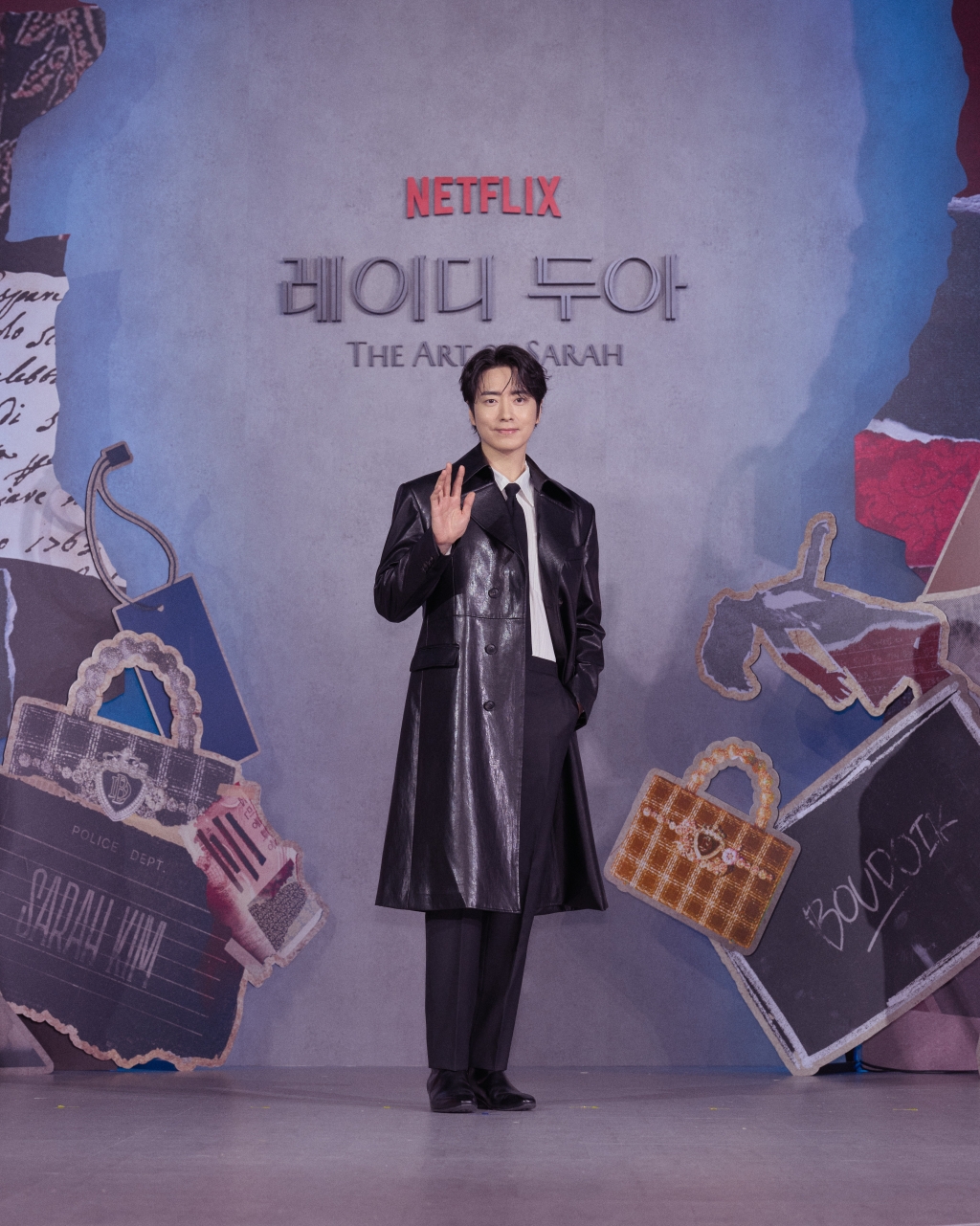
Park Mu-gyeong functions as more than an investigator; he represents a belief system under threat. His pursuit of Sarah is driven by the assumption that truth, once uncovered, will restore order. Yet the world he operates in no longer guarantees that outcome.
Unlike traditional crime narratives, his investigation does not gradually illuminate the truth. Instead, it exposes the limits of procedural logic in environments where reputation outweighs evidence. The closer Mu-gyeong gets, the more apparent it becomes that solving the case may not resolve the unease it creates.
His role becomes paradoxical. By insisting on clarity, he destabilizes the fragile agreements that allow institutions to function smoothly. The series positions his persistence as morally understandable but structurally inconvenient. Truth, here, is not suppressed because it is false, but because it is disruptive.

Luxury as an Ethical Blind Zone
The setting of the luxury industry is not incidental. Luxury operates as a moral buffer, transforming excess into aspiration and inequality into aesthetic order. Within this space, authenticity becomes a branding exercise rather than an ethical question.
Sarah’s presence feels earned because she looks right. The series underscores how visual alignment replaces verification. Wealth, elegance, and cultural fluency act as proxies for credibility. In such an environment, exposure threatens not just an individual but the illusion of discernment the industry depends on.
This dynamic reframes deception. Lying is no longer an act of malice but a method of participation. The system rewards those who understand its visual grammar and punishes those who insist on literal truth. Sarah’s mastery of this grammar makes her less an outlier and more an ideal product of the system.
Performance as Survival, Not Deception
What distinguishes The Art of Sarah from conventional thrillers is its refusal to moralize performance. Acting is not treated as dishonesty but as adaptation. Every character performs to some degree, adjusting their behavior to fit expectations and maintain position.
Sarah’s shifting identities do not signal instability; they demonstrate control. Each version of herself is calibrated to context, suggesting that flexibility, rather than sincerity, is the most valuable trait in competitive hierarchies. In contrast, Mu-gyeong’s emotional restraint and procedural rigidity begin to read as vulnerabilities.
The series quietly questions whether consistency is truly ethical, or merely comfortable. By framing performance as survival, it destabilizes the binary between truth and falsehood. What matters is not whether something is real, but whether it functions.
Gendered Expectations and the Cost of Visibility
Sarah’s visibility amplifies the stakes of her performance. As a woman in a position of symbolic power, she is subjected to contradictory expectations: to be flawless yet transparent, authoritative yet approachable. The series uses these pressures to explain, rather than excuse, her strategic opacity.
Her refusal to be fully legible becomes an act of self-preservation. Total transparency would not humanize her; it would expose her to dismantling. The narrative suggests that for certain figures, especially women in elite spaces, mystery is not a flaw but a shield.
This framing complicates the audience’s desire for revelation. Wanting to “know” Sarah begins to feel invasive, even complicit in the systems that demand constant justification from those who do not fit neatly into inherited power structures.
Why Exposure Fails to Deliver Justice
Traditional thrillers promise catharsis through exposure. The Art of Sarah withholds that promise. Even when fragments of truth surface, they do not realign the moral universe. Instead, they reveal how adaptable institutions are in absorbing disruption without fundamental change.
Exposure becomes symbolic rather than corrective. It satisfies curiosity but leaves structures intact. This refusal of narrative closure is deliberate. The series argues that justice cannot operate effectively in systems that prioritize stability over accountability.
Mu-gyeong’s frustration mirrors the audience’s. The more we learn, the less certain we become that knowledge alone is transformative. Truth, stripped of consequence, becomes another aesthetic object—acknowledged, discussed, and ultimately neutralized.
What the Series Ultimately Examines
At its core, The Art of Sarah is not about crime, deception, or even desire. It is about authorship. Who gets to define reality? Who controls the narrative frame? And what happens when identity is treated as a project rather than a given?
Sarah and Mu-gyeong are not opposites but parallel responses to the same environment. One adapts by mastering performance; the other resists by insisting on exposure. Neither approach offers resolution. Together, they map the boundaries of agency in systems designed to reward appearance over substance.
An Ending That Leaves the Question Open
Rather than offering answers, the series leaves viewers with a disquieting recognition. If identity can be crafted convincingly enough to override truth, then authenticity is no longer a moral absolute—it is a strategic choice.
The lingering question is not whether Sarah is real or fake, but whether reality itself has become negotiable. And if so, what role does truth play in a world where belief is easier to manufacture than trust?
The Art of Sarah does not resolve this tension. It invites the audience to sit with it—and to consider how often they already do.