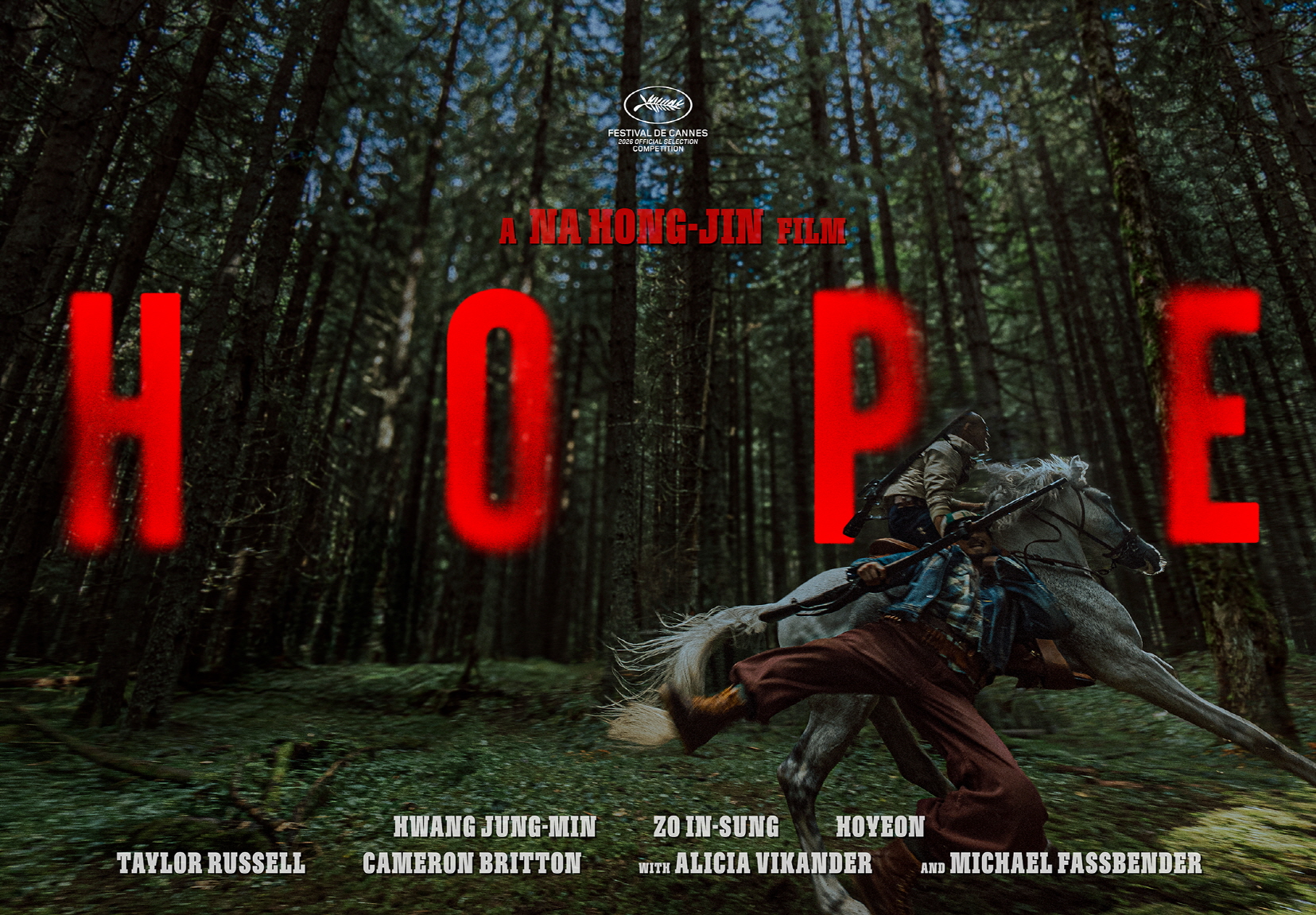
Na Hong-jin has never been a director who treats genre as a fixed contract. His films usually begin inside recognizable forms like the serial-killer chase, the noir pursuit, or the possession mystery, only to turn those forms unstable from within. That is why HOPE matters before most viewers have even seen it. Its significance is not simply that it has entered the 2026 Cannes Competition and secured North American distribution through NEON, but that it appears positioned as a test of whether Na can expand his cinema from local dread into something closer to global-scale myth without losing the moral grime that made his earlier work unforgettable.
Na Hong-jin has always used genre to trap people, not to entertain them safely
What separates Na from many prestige genre filmmakers is that his movies do not offer the pleasure of control. The Chaser did not behave like a satisfying procedural. The Yellow Sea pushed noir into exhaustion and bodily panic. The Wailing made explanation itself feel like a curse. Cannes has tracked that trajectory for years, with Na appearing there multiple times across his career.
That history matters because HOPE arrives not as an isolated comeback, but as the next escalation in a career built on destabilizing familiar expectations. Na’s strongest films do not merely ask whether evil exists. They ask whether ordinary people are structurally incapable of understanding the thing that is destroying them. His cinema is full of characters who misread signs, follow the wrong logic, or arrive at knowledge only when it is too late to matter. If HOPE extends that pattern into a science-fiction thriller setting, then the genre shift is not cosmetic. It could become the most direct expression yet of Na’s core obsession: the humiliation of human certainty.
That is why the premise is more important than it first sounds. A report of a tiger near a DMZ-adjacent village already creates a false frame, something concrete and legible that a community can organize around. A dangerous animal is frightening, but it is still a comprehensible problem. Na’s films often begin with exactly that kind of manageable explanation before slowly revealing that the real threat belongs to a different category altogether. The early “wrong answer” is never filler in his work. It is the point. It shows how badly people need the world to remain classifiable.
The move toward science fiction may actually make Na more fully himself
The label “science-fiction thriller” can mislead people into expecting technological spectacle or an internationally polished genre package. That would miss what makes Na interesting. His films have always been less about systems than about contamination. He does not build clean worlds. He builds worlds where panic spreads faster than evidence and where reality feels infected before it is understood.
In that sense, science fiction may be the natural next step for him rather than a departure. Horror in The Wailing already operated like an epistemological crisis. The supernatural was terrifying not just because it was violent, but because it dissolved every stable method of interpretation. A science-fiction framework can intensify that same instability. It allows Na to ask what happens when the unknown is not folklore or religion but something even harder to place within communal memory. Folklore at least offers inherited language. A genuinely alien intrusion does not.
That shift could also make HOPE more radical than a standard “Korean auteur goes global” narrative suggests. Much cross-border prestige cinema becomes smoother as it grows bigger. The storytelling turns more legible, the themes more portable, the ambiguity more market-tested. Na’s value has always come from resisting that smoothing process. His stories lurch, misdirect, and suffocate. If he brings that same method into a film with larger scale and broader international attention, then HOPE may not represent a softening of his cinema for global circulation. It may represent the opposite: a demand that global audiences enter his cinema on his terms.
The setting near the DMZ suggests a border story, but borders in Na’s films never hold
A village near the Demilitarized Zone is not just a dramatic backdrop. It is a loaded symbolic space. The DMZ has always carried multiple meanings at once: national division, suspended war, surveillance, militarized waiting, and the strange normality that grows around permanent emergency. Setting HOPE in a place like that invites a reading that goes beyond plot. This is a geography built around the fantasy that borders can contain danger while also proving, every day, that fear leaks through every system meant to manage it.
That is precisely the kind of contradiction Na likes. His stories often begin in communities that believe they can identify insiders and outsiders, causes and effects, victims and threats. Then those distinctions corrode. The village becomes a moral laboratory where everyone’s confidence starts to break down. In a DMZ-adjacent setting, that breakdown can resonate at several levels at once. The unknown threat is not only local. It unsettles one of the most politically charged landscapes in Korea, a space already defined by uncertainty, rumor, and layered violence.
What makes this especially potent is that Na rarely treats place as mere atmosphere. His locations feel like psychological systems. The rain-soaked alleys of The Chaser, the transnational bleakness of The Yellow Sea, and the mountain village unease of The Wailing all shaped how their characters perceived danger. A remote harbor community near the DMZ can therefore do more than create tension. It can stage a clash between old communal instincts and a threat that may be fundamentally unreadable. The setting does not simply support the story. It becomes the story’s first philosophical argument: people build borders because they want the unknown to stay outside, yet history keeps showing that the unknown is already inside the structure.
NEON’s involvement signals more than distribution power
NEON’s acquisition of North American rights matters partly because of reach, but mostly because of framing. The company has built a powerful identity around turning festival films into cultural events for U.S. audiences, and its Cannes record has become unusually influential in shaping which international titles travel with momentum into broader film conversation. That makes HOPE more than another imported genre title. It is being positioned as a major object of cinephile attention from the outset.
There is a deeper consequence to that kind of positioning. Distributors do not just release films. They teach audiences how to see them. A NEON-backed rollout encourages viewers to approach HOPE not as niche Korean genre fare, but as a high-stakes work in contemporary world cinema. That distinction matters because Na’s films have often lived in two categories at once: they are viscerally accessible, yet critically difficult to reduce. A distributor skilled at handling both prestige and provocation is unusually well matched to that tension.
Still, the more interesting question is whether this partnership changes the expectations around the film in ways that Na may choose to resist. Once a work enters Cannes Competition under a banner like NEON, it arrives surrounded by institutional confidence. Audiences start looking for the “important” reading. They expect thematic coherence, awards-ready seriousness, and the kind of symbolic neatness that many festival narratives reward. Na has never really made films that sit still for that sort of interpretation. His best work feels too unruly, too suspicious of human explanation, to be completely domesticated by prestige discourse.
A larger international cast may widen the film’s scale without changing its emotional logic
One reason HOPE draws immediate attention is its international cast and apparent expansion beyond the more locally bounded frameworks of Na’s earlier features. Yet scale alone does not determine artistic consequence. The real issue is whether international presence functions as ornament or as structural pressure.
Na has always been preoccupied with breakdowns in communication. People in his films rarely share stable meaning even when they share language, religion, or social codes. Bringing together Korean performers and international actors could intensify that dynamic rather than dilute it. The film may not use global casting to look cosmopolitan. It may use it to render alienation more literal, more visible, and more impossible to resolve through simple empathy.
That would align with a recurring feature of Na’s work: he does not trust recognition. The face in front of you, the authority you rely on, the explanation you accept, all of these can become traps. A broader cast can deepen that suspicion by making every encounter feel potentially cross-coded, every alliance unstable, every appearance misleading. In a director less severe than Na, multinational casting might signal accessibility. In his hands, it may become one more device for disorientation.
What is really at stake is whether Na can scale up dread without making it abstract
Many directors can become “bigger.” Fewer can become bigger without losing density. Na’s films work because they make fear tactile. Bodies sweat, stumble, bleed, and decay. Panic is not conceptual. It is physical, humiliating, and immediate. The risk with a film like HOPE is that enlarged scope could turn dread into atmosphere rather than experience.
But there is also a reason to think the opposite may happen. Na’s strength has always been escalation through texture. He understands that the unknown becomes more frightening when it invades a world that feels materially specific. If HOPE preserves that grounded brutality while opening outward into science fiction, then the film could achieve something rare: a speculative work that feels less like abstract world-building and more like a wound spreading through a recognizable human environment.
That may be the deepest reason the film already feels important. It stands at the intersection of several temptations that often flatten directors: internationalization, festival prestige, genre expansion, and long-awaited comeback status. Any one of these can push a filmmaker toward self-imitation or self-canonization. What makes HOPE intriguing is the possibility that Na will use all of them as fuel for further destabilization instead.
And that leaves the most interesting question unresolved. If Na Hong-jin has spent his career showing how fragile human interpretation is when confronted by violence, evil, or the inexplicable, what happens when he finally gives that crisis a scale large enough to exceed not only a village or a case, but perhaps even the frameworks audiences usually use to read a Na Hong-jin film at all?