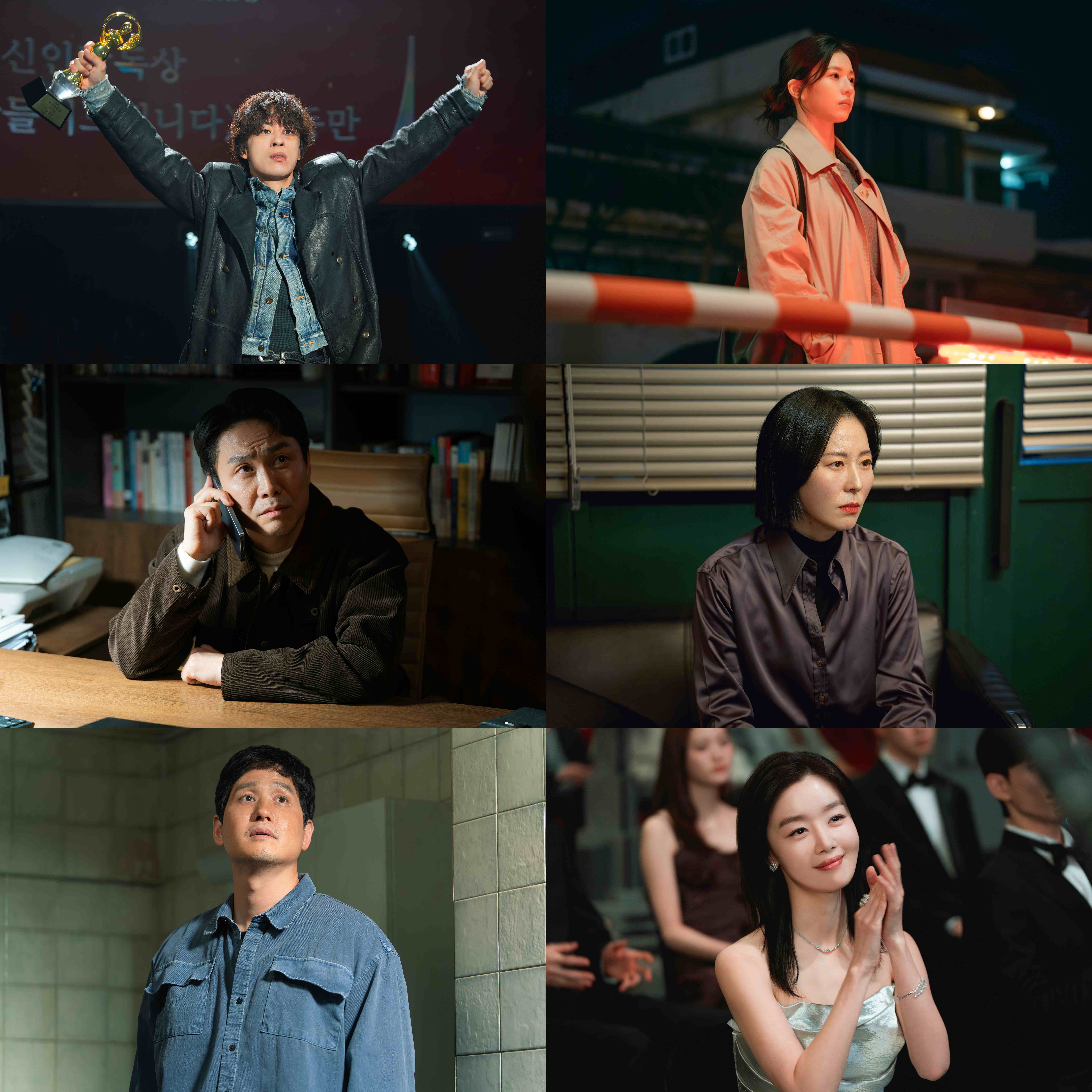
JTBC’s We Are All Trying Here reaches its midpoint without treating insecurity as a temporary obstacle to overcome. That choice changes the emotional direction of the series entirely. Most contemporary dramas frame pain as a problem waiting for resolution, but this story keeps returning to a more uncomfortable question: what if the fear of being unnecessary never fully disappears?
That is why the series feels less like a conventional healing drama and more like an examination of modern survival. Every character measures their value through productivity, recognition, love, or usefulness, yet none of those systems actually provide stability. The drama’s emotional force comes from watching people continue anyway. Not because they suddenly become confident, but because they slowly realize everyone around them is equally fragile.
Hwang Dong-man’s unfinished screenplay matters because it exposes how creativity becomes proof of existence
Hwang Dong-man’s obsession with We Make the Weather is not really about artistic ambition. The screenplay functions as evidence that his life still has direction. The longer he fails to finish it, the more society interprets him as someone who has already expired socially. The drama understands how brutal that judgment becomes for middle-aged men whose worth is tied almost entirely to visible achievement.
What makes Dong-man compelling is that the series refuses to romanticize failure. People around him openly see him as pathetic. Even he internalizes that perception. Yet the story also suggests that humiliation itself can distort creativity. His writing paralysis is not simply laziness or lack of talent. It comes from believing every sentence must justify his existence.
That is why Eun-ah’s feedback becomes transformative. She does not merely improve the script structurally. She identifies the emotional absence at its center: “power.” The important detail is that Dong-man realizes his protagonist lacks power because he does. The screenplay suddenly becomes autobiographical in a way he had been avoiding for years.
The series is strongest when it connects artistic creation with emotional exposure. Once Dong-man stops protecting himself from vulnerability, writing becomes easier. That shift says something larger about how people mistake emotional self-defense for survival, even when it quietly destroys their ability to connect, create, or move forward.
Byun Eun-ah’s trauma is frightening because it never became a memory
Eun-ah’s story works because the drama treats childhood abandonment as something physical rather than symbolic. Her nosebleeds are not decorative trauma signals inserted for melodrama. They show how fear remains trapped inside the body long after logic says the danger is over.
The series repeatedly emphasizes that her greatest wound was not simply being left alone. It was having to behave normally while terrified. Going to school, eating alone, sleeping alone, pretending nothing happened — those details matter because they reveal how children learn to perform emotional stability before they actually possess it.
That performance continues into adulthood. Eun-ah appears functional, intelligent, and emotionally sharp, but the drama hints that much of her identity was constructed around preventing abandonment from happening again. Even her rejection of the word “mother” feels less like hatred and more like self-protection. Language itself becomes dangerous.
The reveal that her original name was Byun Si-on adds another layer to this struggle. Names in Korean dramas often symbolize rebirth, but here the name change feels defensive rather than liberating. She did not create a new self because she healed. She created one because the previous self was abandoned.
What makes this arc especially powerful is that the series does not promise reconciliation. Many family dramas eventually soften abusive or neglectful parents through sentimentality. Bae Jong-ok’s Oh Jung-hee instead represents a different kind of cruelty: the ability to continue living elegantly while someone else remains emotionally frozen in the past.
Every supporting character reveals a different survival strategy against shame
One reason the drama feels emotionally dense is that no character exists merely to support the leads. Everyone operates within their own private war against inadequacy.
Park Kyung-se’s insistence on solo writing reflects insecurity disguised as artistic purity. He sees collaboration as proof that he is insufficient alone. Ko Hye-jin’s desperation for financial stability exposes how economic anxiety erodes dignity over time. Hwang Jin-man’s alcoholism turns incompetence into self-destruction rather than recovery.
Even Jang Mi-ran’s conflict with her actress mother reflects another form of emotional suffocation. She feels trapped between emotional intuition and an image-driven worldview where performance matters more than sincerity. The drama repeatedly asks whether people can still recognize genuine affection after years of performing ideal versions of themselves.
The “8-member group” storyline also matters more than it initially appears. Their discomfort around Dong-man suggests a deeper moral anxiety: people often exploit vulnerable individuals creatively while refusing to acknowledge the debt afterward. The series quietly critiques industries built on emotional extraction, especially artistic spaces where personal suffering becomes marketable material.
This collective structure is important because the show refuses individual exceptionalism. No single character is uniquely broken. Their emotional conditions are systemic. Everyone feels replaceable. Everyone fears becoming unnecessary. The characters differ only in how they disguise those fears.
The drama’s real subject is compassion, not recovery
Most healing narratives are ultimately optimistic about self-worth. They imply that people eventually discover hidden value within themselves. We Are All Trying Here appears more skeptical than that.
Dong-man’s line about being “exactly as unhappy and happy as everyone else” may become the defining idea of the series. It rejects the fantasy of total emotional victory. Instead, it suggests adulthood is about coexistence with disappointment rather than escape from it.
That perspective aligns closely with the writing style associated with Park Hae-young. Her characters rarely achieve dramatic emotional breakthroughs. They survive through recognition — the painful realization that everyone else is exhausted too.
The series therefore treats empathy almost as a political act. In a culture obsessed with proving competence, usefulness, and emotional perfection, simply admitting weakness becomes radical. The characters are slowly learning that worth cannot be measured only through achievement, productivity, or public validation.
What makes the second half intriguing is not whether the characters will become “better.” The more difficult question is whether they can stop treating themselves as failures while still remaining imperfect.
That possibility may be the closest thing this drama offers to hope.