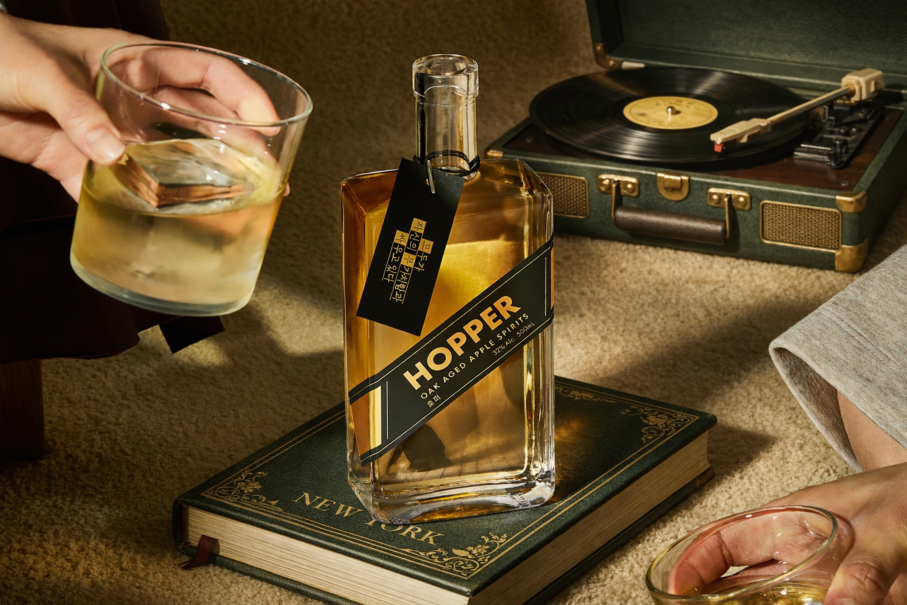
SLL’s decision to extend We Are All Trying Here into a premium apple distillate called HOPPER matters less as a novelty product than as a clue about where drama IP is heading. The series is officially presented in English as We Are All Trying Here, and the collaboration frames the drink not as a souvenir but as an emotional continuation of the show’s world.
A bottle can carry mood better than plot ever could
Most drama merchandise stays at the level of recognition. It gives viewers a logo, a face, a slogan, or a collectible object that proves attachment to a title. That model works when fandom is driven by visibility, but it becomes weaker when a series is built around interiority, hesitation, and emotional exhaustion. A drama like We Are All Trying Here does not naturally lead to loud or decorative merchandise because its core appeal is not spectacle. It is atmosphere.
That is why an aged apple spirit is a more intelligent extension than the usual key ring, poster, or apparel line. Oak aging, slow development, and layered aroma are all sensory ideas that can be linked to emotional sediment: disappointment that lingers, loneliness that matures rather than disappears, and self-worth that is not restored in one dramatic breakthrough. A product built on time and depth fits a story about people who cannot easily escape their own private sense of insufficiency.
The smartest part of this move is that it does not try to simplify the drama into an inspirational slogan. Instead, it accepts ambiguity. Distilled liquor is rarely a cheerful medium. It suggests bitterness, warmth, aftertaste, and memory. Those qualities let the product echo a difficult emotional register without flattening the series into easy consolation. That matters because audiences increasingly resist merchandise that feels mechanically attached to a title rather than organically derived from it.
The name “HOPPER” turns the collaboration into an interpretation
The naming is doing almost all the heavy lifting here. “HOPPER” clearly invites two readings at once: the figure who keeps hoping, and the emotional world associated with Edward Hopper’s lonely modern spaces. That double meaning gives the project a level of conceptual coherence that most IP goods never reach.
This matters because contemporary content branding often fails when it explains itself too literally. A drink called after a character or a catchphrase would have been easy to understand, but easy to understand is not the same as worth remembering. “HOPPER” works because it leaves room for association. It is not just branding; it is a reading of the drama. It suggests that isolation is not merely a personal weakness in the story, but a structure of modern life. The reference moves the series out of a single Korean television context and into a wider emotional vocabulary of urban alienation, stalled ambition, and quiet despair.
That kind of naming also flatters the audience in a useful way. It assumes the buyer wants more than ownership. It assumes they want interpretation. In a crowded merch economy, that is an important shift. Consumers do not only want products connected to stories; they want products that prove someone understood the story in the first place.
Traditional liquor is not a nostalgic prop here; it is a strategy of seriousness
There is another reason this collaboration stands out. SLL did not attach the drama to a novelty cocktail mix or a brightly packaged convenience drink. It chose a traditional-liquor framework, developed with a curation and distribution partner and tied to a premium apple distillate made from Yesan apples. In product terms, that positions the collaboration closer to craft and connoisseurship than to impulse fandom. In industry terms, it signals that IP commerce is moving upward, not just outward.
That distinction matters because premiumization changes the relationship between story and purchase. Low-cost merch usually depends on immediacy: buy now because you love the show right now. Premium consumables work differently. They ask the buyer to see the title as part of lifestyle, taste, and self-image. Once that happens, the drama stops being a temporary entertainment property and starts behaving more like a cultural brand.
Traditional liquor also adds a layer of cultural anchoring that imported luxury cues could not provide. Apple distillate, local sourcing, and oak-aged craftsmanship all create an impression of rootedness. For a series about fragile self-worth and emotional fatigue, that rootedness has symbolic force. It implies that modern instability can still be held inside older forms of patience and making. The message is subtle, but powerful: not every response to alienation has to look futuristic. Sometimes the answer is slower, older, and more tactile.
This is really about turning passive viewing into embodied consumption
SLL’s broader logic is becoming easier to read. Drama is no longer treated as something audiences simply watch and discuss. It is becoming something they enter through places, objects, flavors, and rituals. Pop-ups, MD, stage adaptations, and now liquor all point in the same direction: the IP is valuable not because it can be repeated, but because it can be re-experienced in different forms.
That is a meaningful evolution in entertainment economics. Streaming made access easier, but it also made individual titles more disposable. A viewer can finish a series and move on in a weekend. IP commerce responds to that speed by trying to slow the audience down again. It inserts the drama into ordinary routines: shopping, gifting, collecting, dining, drinking. The goal is not only extra revenue. It is duration.
What makes HOPPER notable is that it attempts this without breaking the emotional identity of the source material. Many cross-category brand extensions fail because they create a tonal contradiction. A melancholy drama gets cheerful merchandise. A psychologically dense story gets flattened into decorative fandom. Here, the category itself carries enough gravity to avoid that mismatch. Drinking is reflective, social, solitary, ceremonial, and sometimes melancholic. That makes it unusually compatible with a series built around inner lack.
The collaboration hints at a new kind of K-drama consumer
There is also a demographic reading beneath all of this. The release language positions the product between MZ taste culture and premium-spirit buyers, which suggests that the intended consumer is not just a fan but a curator of lifestyle signals. In other words, the ideal buyer is someone who wants their cultural consumption to say something about discernment. They do not merely watch a critically interesting drama; they choose the bottle that extends its emotional world.
That shift is important because it reflects how K-drama is being reclassified in the market. It is no longer only mass entertainment or fandom culture. Increasingly, certain titles are being treated as design-sensitive, mood-driven properties that can travel into adjacent categories with relatively high symbolic value. When that happens, the drama becomes closer to a fashion label, art book, fragrance concept, or boutique food collaboration than to traditional TV merchandise.
For producers, this opens an attractive path. A successful extension does not require blockbuster scale if the property has a distinctive emotional identity. In fact, dramas with quieter but sharper tonal signatures may be better suited to this model than flashy mainstream hits. Their audiences are often more motivated by mood, authorship, and interpretation. Those are exactly the conditions under which premium collaborations feel justified rather than opportunistic.
What looks like commerce is really a test of narrative confidence
The most revealing thing about HOPPER may be that it asks a basic question: does this drama have a world strong enough to survive outside the screen? Many titles do not. They have events, twists, and stars, but not a portable sensibility. Once the episode ends, there is nothing to inhabit.
A collaboration like this only works if the underlying series has an emotional architecture people recognize immediately. Not the plot, but the feeling. Not the scene, but the residue it leaves behind. The decision to build a premium spirit around We Are All Trying Here suggests confidence that the series possesses that kind of afterlife. The bottle is a wager that the show’s tone can be consumed, remembered, and shared without needing to be explained first.
That is why the project deserves attention beyond its commercial novelty. It is not just another branded product. It is a measure of how far Korean drama production has moved toward sensory world-building. The question is no longer whether a series can generate merchandise. Almost anything can. The harder question is whether the merchandise can deepen the meaning of the series rather than merely monetize its visibility.
If more IP collaborations follow this route, the most successful ones may not be the loudest or the most collectible. They may be the ones that understand an audience’s attachment as something more intimate: not devotion to characters alone, but recognition of a feeling they have not been able to name. In that sense, HOPPER is less about selling alcohol than about testing whether a drama about worthlessness, loneliness, and fragile hope can become a material experience. The more interesting question is what happens when viewers start expecting that level of emotional precision from every IP product that follows.