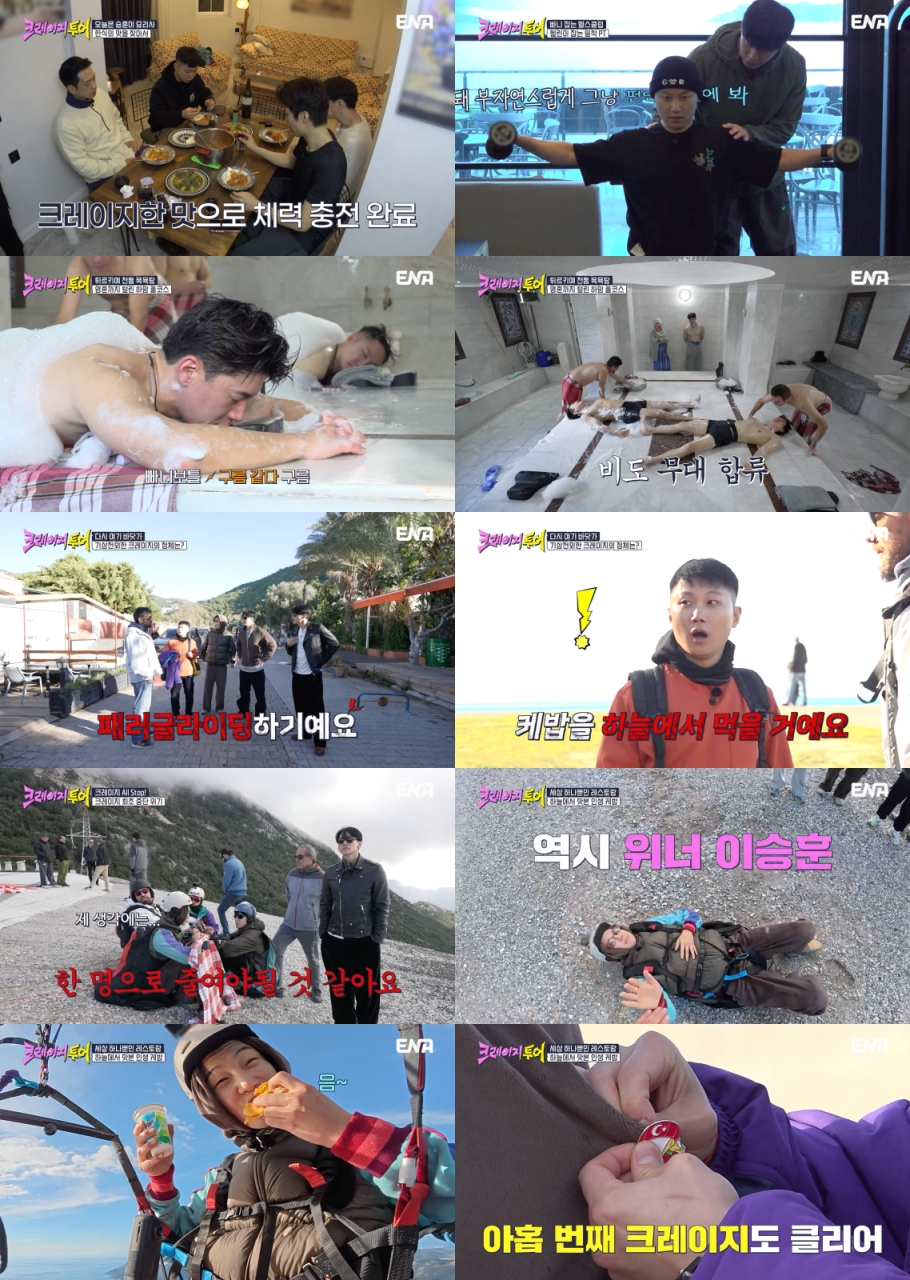
A travel show becomes more interesting when the destination stops being the main subject. ENA’s Crazy Tour uses Turkey not simply as scenery, but as a pressure chamber where fatigue, fear, pride, and care become visible. Episode 9 matters because its biggest spectacle is not only paragliding over the Blue Lagoon, but watching Lee Seung-hoon become the emotional center of a group built around risk.
The youngest member becomes the stabilizing figure
Lee Seung-hoon’s role works because he does not compete with the older members through force. Instead, he shifts the mood through practical care: cooking, joking, observing, and stepping forward when the situation demands it. His Korean-style meal is not just comfort food; it becomes a small act of repair after the group’s physical exhaustion.
That matters because variety shows often treat the youngest member as comic relief. Here, the “maknae” becomes the person who quietly holds the team together. His fear before the paragliding mission makes his final success feel less like a stunt and more like emotional payoff.
The hamam sequence shows why rest can be more revealing than action
The Turkish hamam scene works because it lowers the group’s defenses. After workouts, oil wrestling, travel fatigue, and constant missions, the members are placed in a setting where they cannot perform toughness. They are washed, turned, scrubbed, and cared for almost like children.
This matters because Crazy Tour is not only about dopamine. Its stronger moments come when extreme travel exposes dependence. The hamam turns four competitive men into people willing to surrender control, and that softness gives the later aerial challenge more emotional contrast.
Rain and Kim Moo-yul represent discipline, while Pani Bottle exposes the cost of it
Rain and Kim Moo-yul’s gym energy is funny because it is excessive, but it also reveals the show’s internal hierarchy. They treat the body as something to train, push, and discipline. Pani Bottle, surrounded by their enthusiasm, becomes the viewer’s proxy: curious, overwhelmed, and always looking for the exit.
This contrast matters because it prevents the show from becoming a simple celebration of toughness. The comedy comes from imbalance. One person’s “healthy routine” becomes another person’s survival mission, and the show understands that discomfort is funnier when everyone involved remains human.
“Kebab in the Sky” works because the failure risk is real
The paragliding challenge could have been just another visual spectacle. What makes it stronger is the delay, the weather uncertainty, and the final reduction from a group mission to one participant. The mission changes shape because reality interrupts production design.
That matters because unscripted travel content often loses tension when challenges feel too controlled. Lee Seung-hoon eating a kebab in the sky becomes memorable not because it is absurd, but because the path to that image is unstable. The show earns the moment by letting hesitation, waiting, and disappointment remain part of the episode.
The episode’s real subject is not courage, but shared regret
Lee Seung-hoon’s flight is triumphant, yet his reaction afterward is not pure victory. His wish that the others could have joined him gives the scene its emotional weight. The badge-sharing moment also softens the idea of individual success; even a solo mission becomes group memory.
That is why Episode 9 feels more layered than a typical travel-variety highlight. It asks whether adventure is still complete when it cannot be shared in the way it was imagined. The answer remains open, and that uncertainty is what makes the moment linger.
Crazy Tour finds its best energy when absurd missions reveal ordinary needs: food, rest, encouragement, pride, and companionship. The sky-high kebab may be the image people remember, but the deeper question is quieter: when travel pushes people past comfort, who becomes braver, and who becomes kinder?