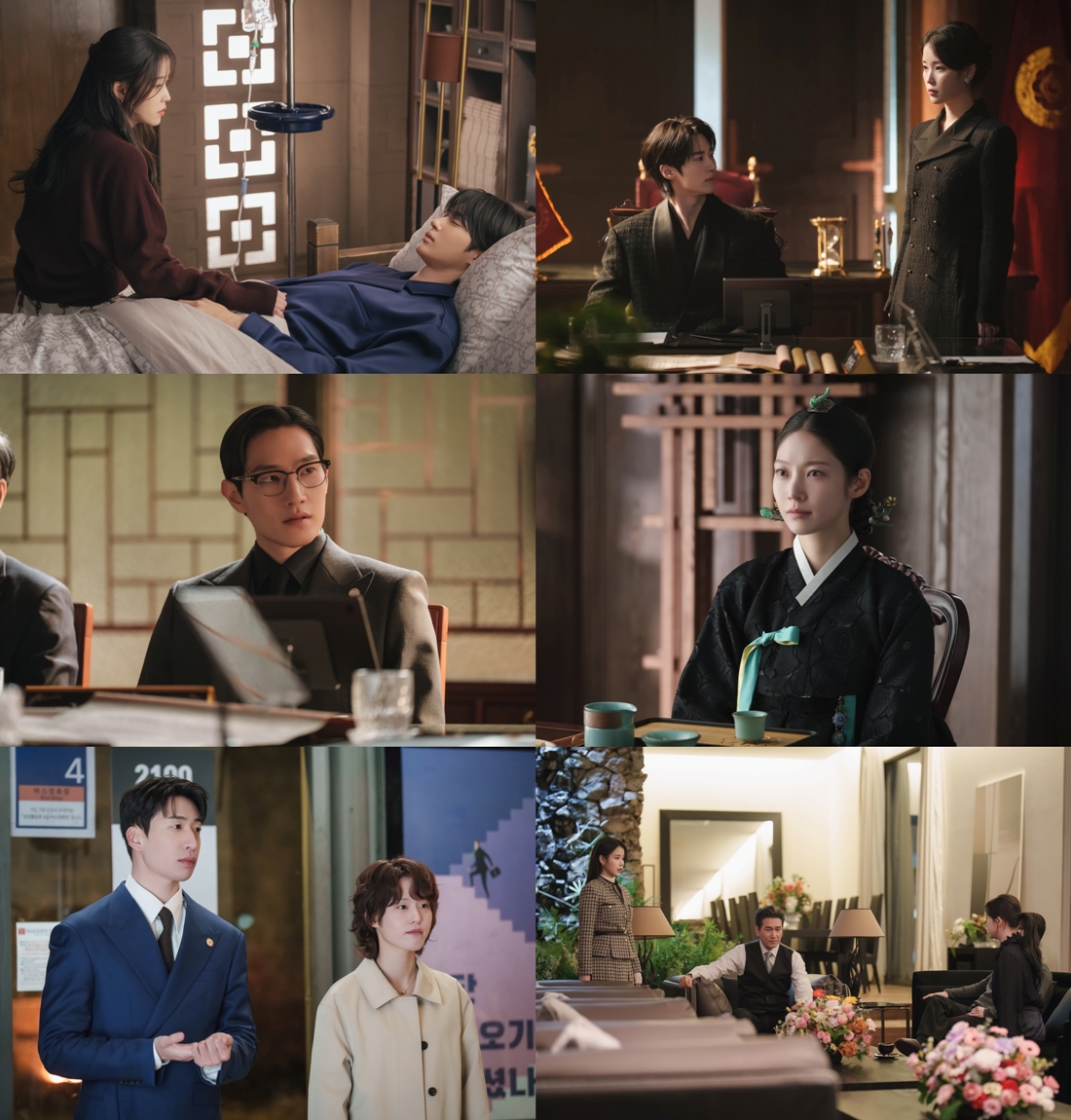
In many contemporary romance dramas, marriage functions as the emotional destination. In Perfect Crown, marriage becomes the beginning of a larger confrontation. The relationship between Seong Hui-joo and Grand Prince Ian is no longer framed as a fantasy escape from social hierarchy, but as a direct challenge to the system that created those hierarchies in the first place. That shift explains why the drama’s final episodes feel less concerned with simple romantic closure and more invested in whether intimacy itself can survive inside structures built around power, lineage, and control.
The series consistently treated love as something political. Even when the contract marriage premise initially appeared to follow familiar K-drama conventions, the story gradually revealed that the arrangement mattered because it exposed how status determines personal freedom. Hui-joo and Ian did not merely fall in love despite external pressure. Their relationship forced the royal institution and political elite to confront contradictions they preferred to ignore. By the final week, the central question is no longer whether the couple loves each other. The real uncertainty lies in whether that love can remain intact once it becomes tied to public responsibility and symbolic authority.
The drama’s strongest idea is that social status creates emotional isolation
One reason the romance resonates is the way the series portrays privilege as emotionally destructive rather than glamorous. Ian’s royal identity repeatedly limits his ability to act honestly, while Hui-joo’s position forces her into constant negotiation with people who see marriage as strategy rather than companionship. Their chemistry works because both characters understand isolation differently but recognize it in each other.
This becomes especially important near the finale because Ian’s decision to carry the burden of the crown changes the emotional balance of the relationship. Earlier episodes positioned Hui-joo as the character struggling most directly against social expectations. Now Ian faces the possibility that accepting institutional power could gradually transform him into the kind of figure he once resisted. The looming threat is not simply physical danger or political sabotage. It is the fear that power inevitably reshapes identity.
That tension gives the romance unusual weight. Many dramas use royal or elite settings as decorative fantasy. Perfect Crown instead treats status as a mechanism that distorts human relationships. The closer Ian moves toward authority, the more uncertain genuine intimacy becomes. The romance therefore evolves into a test of whether personal loyalty can exist independently from political obligation.
Min Jeong-woo represents how wounded desire turns into authoritarian obsession
The most revealing character in the final stretch may not be the male lead, but Prime Minister Min Jeong-woo. His trajectory reflects one of the drama’s recurring themes: people who cannot emotionally adapt eventually attempt to control others instead. Jeong-woo’s fixation on Hui-joo becomes dangerous precisely because he interprets love as possession rather than mutual recognition.
What makes the conflict compelling is that the series avoids presenting him as purely evil. His rivalry with Ian carries emotional history, disappointment, and resentment tied to class and ambition. The breakdown of their friendship mirrors the broader collapse of trust within the political system itself. Personal betrayal and institutional corruption become almost indistinguishable.
This matters because Jeong-woo embodies a worldview fundamentally opposed to the central couple’s relationship. Hui-joo and Ian grow stronger through reciprocity and sacrifice. Jeong-woo pursues dominance. The contrast suggests that the drama sees emotional maturity not as softness, but as the ability to resist turning pain into entitlement.
His downfall therefore carries symbolic importance beyond the love triangle narrative. The series appears less interested in punishing jealousy than in exposing how power structures reward emotional manipulation. Jeong-woo becomes the logical product of a system where influence matters more than empathy.
Yoon Yi-rang’s arc reframes ambition through the lens of parenthood
Another intriguing aspect of the final episodes is the evolution of Yoon Yi-rang. Earlier in the series, she often appeared trapped within cycles of ambition inherited from older generations. Yet the later narrative increasingly shifts her motivation toward protecting her son from repeating those same patterns.
This development complicates the drama’s treatment of power. Instead of dividing characters cleanly into heroes and villains, the story repeatedly shows how institutions pressure individuals into reproducing harmful behavior. Yi-rang’s growing awareness suggests that survival inside elite systems frequently demands moral compromise long before characters fully recognize what they have become.
Her arc also deepens the generational dimension of the series. Much of Perfect Crown revolves around inheritance—not only of titles or authority, but of trauma, fear, and emotional expectations. Parents pass down unfinished conflicts to their children, often unintentionally. Yi-rang’s attempt to interrupt that cycle becomes one of the more emotionally significant developments heading into the finale.
The drama ultimately seems less fascinated with revenge than with whether people can break inherited patterns before those patterns define the next generation.
The supporting relationships reveal why the contract marriage premise mattered from the start
One of the more understated strengths of the series is how the contract marriage affects the emotional ecosystem around the protagonists. In lesser dramas, secondary couples often exist purely for comic relief or pacing balance. Here, surrounding relationships function as reflections of the central theme: emotional honesty reshapes social structures.
The growing connection between Choi Hyun and Do Hye-jeong illustrates this particularly well. Their dynamic feels lighter than the main romance, yet it reinforces the drama’s broader argument that authentic connection becomes possible only when people stop performing roles assigned to them by hierarchy or expectation.
Even Hui-joo’s family storyline operates within this framework. Earlier tensions inside the family were rooted in emotional distance disguised as authority and obligation. As external threats intensify, those relationships slowly regain sincerity. Concern replaces control. Protection replaces judgment.
This is where the “contract marriage” concept reveals its real narrative purpose. The arrangement initially looked artificial, but it ultimately forced characters to confront emotions they had spent years suppressing. The drama suggests that performative relationships sometimes expose truth more effectively than socially approved ones.
The ending may matter less than what the couple symbolizes
As the finale approaches, audience curiosity naturally centers on whether Hui-joo and Ian achieve happiness together. Yet the emotional power of the series likely depends less on the final outcome and more on what the couple has already disrupted.
They challenged the assumption that status determines worth. They exposed the fragility of institutions built on emotional repression. Most importantly, they redefined partnership as mutual transformation rather than strategic alliance.
That is why the series feels larger than a standard royal romance. The crown itself is almost secondary. The real conflict concerns whether individuals can preserve emotional integrity while existing inside systems designed to reward conformity and silence.
If the drama succeeds in its final episodes, it will not be because every conflict receives a neat resolution. It will be because the story leaves behind an uncomfortable question: once people recognize the emotional cost of hierarchy, can they ever willingly return to the old order?
'Entertainment & Cultural Analysis' 카테고리의 다른 글
| Why Chef & My Fridge Turns Cooking Into a Test of Identity (0) | 2026.05.17 |
|---|---|
| Why Backrooms Turns Empty Space Into a Collective Fear (0) | 2026.05.15 |
| Why Top Gun Still Feels Modern After 40 Years (0) | 2026.05.13 |
| Why The Horde Signals a New Phase for Korean Genre Cinema and VFX Ambition (1) | 2026.05.12 |
| Why TikTok Is Turning Football Talk Into Platform Entertainment in Korea (0) | 2026.05.11 |